
Choothumani: Earrings that Carry The Heritage of Paniya Community

Updated: Sep 3
For generations, jewellery has been an important part of life in the Paniya community. Among many traditional ornaments worn by Paniya women such as Panathali, Kalle, and Mudechilu, Choothumani stands out for its striking red kunnikuru seeds and the remarkable tradition of wearing it.
The ornament is designed for stretched earlobes, a practice once common among Paniya women and still remembered by many elders today. While fewer young women wear Choothumani in their daily lives, the stories, craftsmanship, and beliefs surrounding it continue to be passed down. Deeply rooted in craft, ritual, and spiritual belief, the Choothumani is a symbol of identity and a connection to the ancestors.
WATCH NOW: Choothumani - Traditional Earrings of the Paniya Tribe
From Forest to Ornament: How Choothumani is Made
The making of Choothumani begins with the forest, with materials gathered from nature.
The base of the ornament is made from kaitha ola (screw pine leaves). Today, finding these leaves has become difficult around the villages where many Paniya families live. Once gathered, the leaves are roasted over hot embers, left outside overnight to absorb the dew, and then dried in the sun. This process changes their colour and texture, making them suitable for crafting.

The process of making Choothumani using kaitha ola (screw pine leaves).
The sharp thorns along both edges are removed before the leaf is rolled into a tight circle, with its ends tucked into one another to form the foundation of the ornament.
On most days, this leaf ornament is worn by itself. For festivals, weddings, and other special occasions, it is transformed into Choothumani with the addition of bright red kunnikuru seeds. In the Paniya language, these seeds are called choothumani, giving the ornament its name. The kunnikuru seeds are usually collected from places around the Valliyoorkkavu temple. So, when the women attend the Valliyoorkkavu festival, they also gather kunnikuru seeds, which are then used to make the choothumani.

Red kunnikuru seeds (rosary pea seeds)
Paniya women also use wax collected from small stingless bees. The wax is cleaned, pounded in a mortar, and mixed with water and charcoal until it forms a smooth black paste. This is flattened and wrapped with the prepared screw pine leaf, creating a firm base that fits securely in the stretched earlobe. Finally, the choothumani seeds are placed, completing an ornament that reflects the craftsmanship, resourcefulness, and cultural knowledge of the Paniya community.
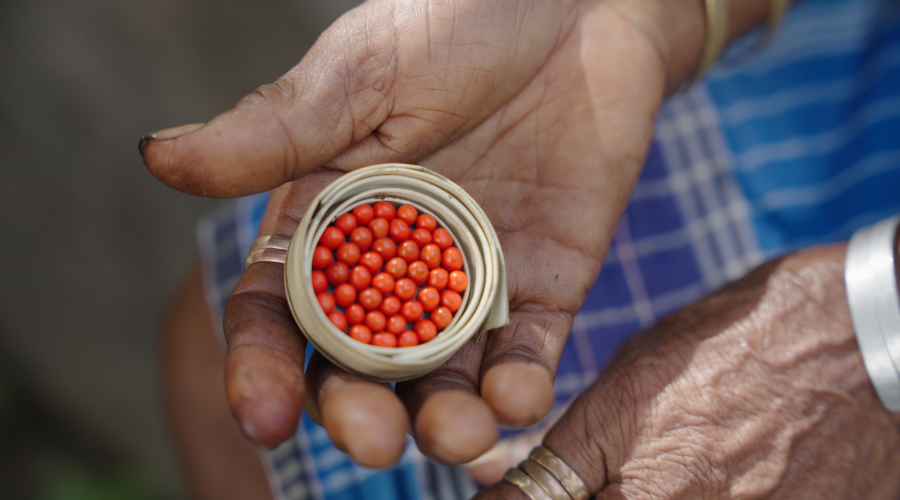
A close-up view of the Choothumani
The Traditional Ear-Stretching Process
The ears are first pierced using a thorn, which is left in place for four days. Once it is removed, the piercing is cleaned with warm salt water, and a thin stick is inserted into the opening. As the ear heals, the stick is replaced with slightly thicker ones, allowing the earlobe to stretch little by little.

An ear adorned with a Choothumani and one without it
Over time, rolled strips of hay are used instead of sticks, with each one slightly larger than the last. This slow, careful process continues until the earlobe is wide enough to hold the traditional ornament.

Screw pine leaf (kaitha ola) earrings, worn by women on occasions when they are not wearing Choothumani
During this period, simple earrings made from screw pine leaves are worn to help maintain the stretched opening. These can be worn for a month or two but are replaced if they become wet or worn out. Through this gradual transformation, the earlobes become ready to wear Choothumani.
From Ancestral Beliefs to Contemporary Practice
The Choothumani holds a sacred place in the spiritual life of the Paniya people. There is a belief that when a woman passes away, her Choothumani must be kept near her head. It is believed that if this ritual is not honored, the deceased will return in the dreams of their family members to seek their missing earrings.

A woman (Onathi) wearing a Choothumani
Despite the spiritual importance, the tradition is fading as younger women often choose not to undergo the difficult ear-stretching process. Observing the disappearance of these designs, community members like Aparna Raj are working to preserve this heritage by creating new expressions of traditional designs like the Choothumani and the Mudechilu (necklace). The dream is to build a jewelry brand that honors the Paniya community, ensuring these ancient crafts are recognized and preserved for the future generations.
Comments